Fortsätt till huvudinnehåll

Shipwreck Aftermath


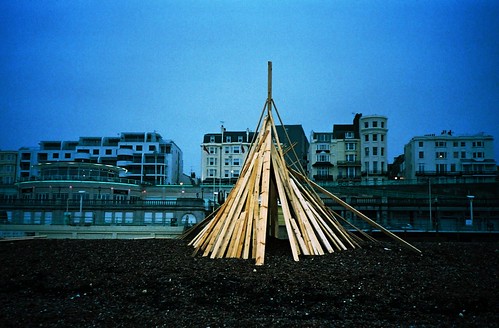
Driftwood Structure, originally uploaded by seadipper.

A week after a ship was wrecked off Portland Bill, masses of timber were washed ashore on the Sussex coast. In Brighton, people were building structures like this on the beach.

Strict warnings were given against taking the timber away, even though it was battered and soaked with seawater. A week later a clean-up team arrived in Brighton. They began by clearing away the structures that people had made. They have some huge machines to collect the timber, consuming huge quantities of diesel.

This morning, because the swimmers can't use their arch because the lock has been glued up for the fifth time since the new year, we made up a fire below high water mark, using odd scraps, and the clearance people with their big machines promptly turned up even though there is a mile of beach they are working on, which looks as if they were trying to intimidate. But they didn't, and we had a nice swim and a warm-up afterwards in front of the blaze.

Apparently the wood is just going to be shredded. There is a mean-spirited way in which the whole thing has been dealt with.

Kommentarer

Populära inlägg i den här bloggen

Importing people to sustain demand

I got involved in a discussion with a Youtuber called “Philosophy all along”. This was in connection with criticism of Trump’s policy of deporting illegal migrants, which he argued would be bad for the economy as it would reduce demand. This implies that there is a need to import people to sustain demand. There is no obvious reason why a population should not be able to consume everything that the same population produces. If it can not, then something else is going on. It is a basic principle that wages are the least that workers will accept to do a job. Wages are a share of the value added by workers through their wages. The remainder is distributed as economic rent, after government has taken its cut in taxes. Monopoly profit is a temporary surplus that after a delay gets absorbed into economic rent. Land values in Silicon Valley are an example of this; it's like a gold rush. The miners get little out of it. Rent and tax syphon purchasing power away from those who produce the g...

The Zombie Train that refuses to die

The Guardian has published a couple more articles against HS2, one by specialist rail commentator Christian Wolmar, and another today by journalist Simon Jenkins. The main arguments in favour will doubtless be wheeled out by the commentators: the need for capacity and the disruption caused by upgrading existing routes. HST itself will severely disrupt services to Euston during the construction period. Capacity can be increased at a fraction of the cost by a variety of measures, provided that it is accepted that the additional traffic will run at existing speeds. It is not generally known that the Midland main line is, or was, four track all the way from London to Trent Junction, between Nottingham and Derby. This is because the additional tracks are separate, having been added for coal trains which trundled down to Brent sidings, on the edge of London, from a collection point at Toton in Nottinghamshire, where the Midland Railway build a huge marshalling yard. Beyond Derby, the main l...

How much more will the British tolerate?

The British are phlegmatic, tolerant and slow to rouse. Thus there was no great reaction after the terrorist attack in July 2005. The murder of Lee Rigby created a sense of outrage, but nothing more, since it appeared to be an isolated incident. Two serious incidents within a fortnight are another matter. Since the first major terrorist incident in 2001, authority has tried to persuade the public that Islam is a religion of peace, that these were isolated events, or the actions of deranged "lone wolves", having nothing to do with Islam, or to reassure that the chances of being killed in a terrorist attack were infinitesimally small. These assurances are are beginning to wear thin. They no longer convince. If government does not act effectively, people will take the law into their own hands. What, however, would effective action look like? What sort of effective action would not amount to rough justice for a lot of innocent people? Given the difficulties of keeping large n...