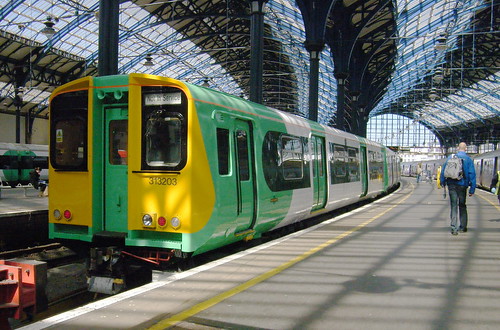
The class 313 suburban trains introduced in the mid 1970s were never the most wonderful of trains. They have been running around in the London area for far too long, but have finally been replaced as London Overground has taken over the routes and introduced new trains.
Now these badly designed trains have been sent to plague passengers on routes along the south coast. To be fair, Southern has got a problem as there is little else available that is suitable, and it has done them up as best it can. New seats are being fitted, one hopes not in the original configuration which is very cramped and gives nobody an unobstructed view out of the train - this is not necessary.
They have no air conditioning, but nor do they have the anti-draught sliding ventilators fitted to the mark 1 stock, and so the windows cannot be opened without causing a draught down the whole length of the carriage. The trains have no toilets and neither do most of the stations any more. This is not good enough, especially when it is apparently intended to use them on the Brighton to Portsmouth run, which takes about 90 minutes. The last time trains without toilets were used on this route was about 1950 and in those days there were toilets on all the stations.
There is also going to be a problem at one of the sharply curved platforms at Lewes. The doors one these trains are closer to the centre of the vehicle than they are on the present Electrostars and there will be an even wider gap between between the platform and the train.
Anticipating an unfavourable reception, Southern has printed leaflets and staged "meet the manager" events locally. Passengers are going to vote with their feet, especially when one must allow 15 minutes at Brighton to get a ticket from the badly designed machines. Over-60s will decide that if they are going to travel in discomfort without access to a toilet, they might as sell go by bus for nothing.
A lot of people will be wishing the slam door stock hadn't been scrapped.
Here is what Southern have to say...
I am sorry that you are not looking forward to the introduction of the Class 313 trains.
We are spending six million pounds refreshing the trains so that they are an improvement on what they were. This refresh will include redesigning the seats so that they are more comfortable and facing each other, meaning that window views will not be obstructed. This will create more room in the aisles.
With regards to the lack of toilets of the 313s, they were not designed to have toilets on board and, in order to provide more space for passengers, they will not be installed. Whilst we are aware that toilet facilities are important, our research shows that the majority of passengers will be making short journeys. We are also working on ensuring that all stations along the line have toilets so that passengers can disembark if necessary.
If you have any further queries about the 313 trains, please feel free to ask a member of staff at our stations or contact us again.
Frankly I think Southern is one of the better train companies and you can't really fault them. Their difficulty is that Britain has a legacy of poorly designed old rolling stock, new rolling stock which can be temperamental, and regulatory requirements which appear to be why they don't seem to be able to solve the ticket machine problem.
Kommentarer