Fortsätt till huvudinnehåll

Advanced steam technology


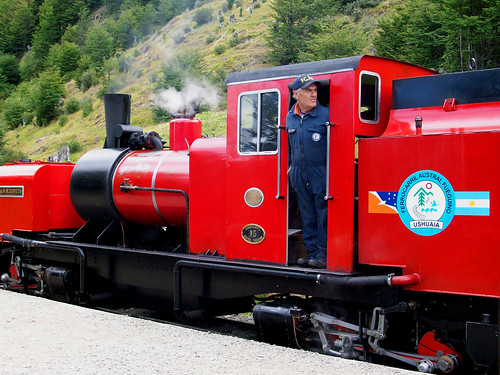
Waiting for a Signal, originally uploaded by Wavellite.

This modern locomotive is little bigger than a toy but embodies very advanced technology. It runs on a tourist railway in Ushuaia in Patagonia. The conical funnel is optimised according to the principles established by Argentinian engineer L D Porta. Not visible is the special water treatment system which, by protecting the boiler, completely eliminates the need for frequent and expensive maintenance.

The main principle of the system is to add sufficient alkali to the water that to raise the pH of the contents of the boiler to a very high level, greater than 10. This is combined with anti-foaming agents to prevent carry-over of harmful substances and damaging material into the cylinders. Any water supply is suitable. When the system is working properly, the water has a brown colouration due to the materials in suspension. This can be observed in the gauge glasses. After a while the interior of the boiler becomes coated with a uniform protective layer that prevents corrosion.There is a complete absence of scale build-up; the solid material remains in suspension and can be cleared by draining the boiler from time to time.
How long does it have to take for prejudices to be overcome and good technology adopted?

Read the technical description here.

Kommentarer

Populära inlägg i den här bloggen

The Zombie Train that refuses to die

The Guardian has published a couple more articles against HS2, one by specialist rail commentator Christian Wolmar, and another today by journalist Simon Jenkins. The main arguments in favour will doubtless be wheeled out by the commentators: the need for capacity and the disruption caused by upgrading existing routes. HST itself will severely disrupt services to Euston during the construction period. Capacity can be increased at a fraction of the cost by a variety of measures, provided that it is accepted that the additional traffic will run at existing speeds. It is not generally known that the Midland main line is, or was, four track all the way from London to Trent Junction, between Nottingham and Derby. This is because the additional tracks are separate, having been added for coal trains which trundled down to Brent sidings, on the edge of London, from a collection point at Toton in Nottinghamshire, where the Midland Railway build a huge marshalling yard. Beyond Derby, the main l...

Importing people to sustain demand

I got involved in a discussion with a Youtuber called “Philosophy all along”. This was in connection with criticism of Trump’s policy of deporting illegal migrants, which he argued would be bad for the economy as it would reduce demand. This implies that there is a need to import people to sustain demand. There is no obvious reason why a population should not be able to consume everything that the same population produces. If it can not, then something else is going on. It is a basic principle that wages are the least that workers will accept to do a job. Wages are a share of the value added by workers through their wages. The remainder is distributed as economic rent, after government has taken its cut in taxes. Monopoly profit is a temporary surplus that after a delay gets absorbed into economic rent. Land values in Silicon Valley are an example of this; it's like a gold rush. The miners get little out of it. Rent and tax syphon purchasing power away from those who produce the g...

Beyond electrification

In an earlier post I suggested a core list of lines which ought to be in an electrification programme spread over twenty years of so. This leaves a residue of routes which it is unlikely will ever be electrified. This include for example All lines beyond Glasgow, Stirling and Aberdeen All lines west of Exeter and Swansea All lines west of Chester Shrewsbury - Chester Everything not listed in my previous blog - electrification plans only scratch surface   Some of these routes carry main line services to London and other cities on parts of the network that are already electrified or included in electrification plans. Others are self contained and others carry light traffic - less than a dozen trains a day. The current plan is that main line services will be operated with the hybrid trains on order from Hitachi, but this is a costly, wasteful and ineffective solution. The performance of the trains will be inferior to the present Inter-City 125 trains on non-electrified lines and the ...