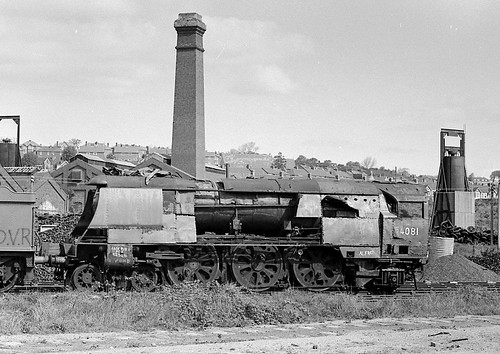
This streamlined locomotive of the Battle of Britain/West Country class was designed by the engineer Bulleid for the Southern Railway during World War 2. It went to the scrapyard in its original form with a streamlined casing, which, as the photograph shows, conceals a conventional locomotive boilder underneath. But most locomotives of the type and all the larger Merchant Navy class were rebuilt with the air smooth casing removed - it was considered a nuisance as it obstructed access. The same happened to the LMS streamlined locomotives, while the Gresley streamliners also had some of the streamlining removed for access and to prevent overheating.
The other problem with these locos was the special chain driven valve gear which ran in an oil bath and there where incidents when the oil caught fire. So the rebuilds had conventional valve gear. But they had outside admission piston valves and these could not be altered easily so there is still (many of these locomotives, including this one, are still running) a potential problem with high pressure steam leaking out through the glands where the rods pass through the steam chests.
It is a pity that Bulleid did not construct to conventional designs in the first place, his locomotives was too clever apart from the utility Q1. On the other hand, he had useful improvements made to a lot of older locos
This is a lesson that present day railway engineers have forgotten, which is why modern trains are plagued with "teething troubles". Watch how the replacement for the HST develops into an expensive repeat performance of the same kind of fiasco.
The Guardian has published a couple more articles against HS2, one by specialist rail commentator Christian Wolmar, and another today by journalist Simon Jenkins. The main arguments in favour will doubtless be wheeled out by the commentators: the need for capacity and the disruption caused by upgrading existing routes. HST itself will severely disrupt services to Euston during the construction period. Capacity can be increased at a fraction of the cost by a variety of measures, provided that it is accepted that the additional traffic will run at existing speeds. It is not generally known that the Midland main line is, or was, four track all the way from London to Trent Junction, between Nottingham and Derby. This is because the additional tracks are separate, having been added for coal trains which trundled down to Brent sidings, on the edge of London, from a collection point at Toton in Nottinghamshire, where the Midland Railway build a huge marshalling yard. Beyond Derby, the main l...
Kommentarer