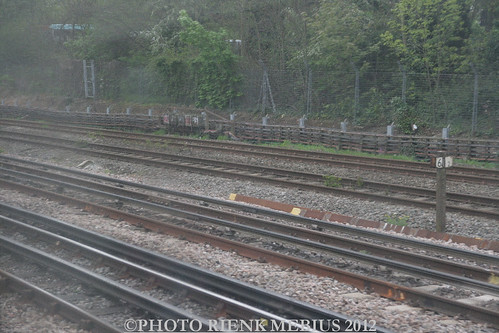
I picked up this picture on Flickr. The far tracks are the lines out of Marylebone. They are not electrified and there are no plans for electrification on this route, which runs only as far as Aylesbury.
At one time it was part of the Great Central and trains ran to Rugby, Leicester, Nottingham, Sheffield and Manchester. The route beyond Aylesbury is largely intact and could be reinstated at relatively little cost as a conventional railway to provide the additional capacity that HS2 advocates insist can be provided only by constructing a high speed line. They assure everyone that it would cost just a teeny-weeny bit more. That sounds implausible.
The Guardian has published a couple more articles against HS2, one by specialist rail commentator Christian Wolmar, and another today by journalist Simon Jenkins. The main arguments in favour will doubtless be wheeled out by the commentators: the need for capacity and the disruption caused by upgrading existing routes. HST itself will severely disrupt services to Euston during the construction period. Capacity can be increased at a fraction of the cost by a variety of measures, provided that it is accepted that the additional traffic will run at existing speeds. It is not generally known that the Midland main line is, or was, four track all the way from London to Trent Junction, between Nottingham and Derby. This is because the additional tracks are separate, having been added for coal trains which trundled down to Brent sidings, on the edge of London, from a collection point at Toton in Nottinghamshire, where the Midland Railway build a huge marshalling yard. Beyond Derby, the main l...
Kommentarer
This then means that it is not able to be electrified (overhead) due to LU rules, so unless a new line was to be built to seperate the two routes (which isn't going to be cheap) the only other way to electrify the line would be to remove the LU services from the line (which isn't going to go down well).
Either way it is not going to be a case of just extneding the existing line.
Likewise, although repoening the Grand Central (GC) line would improve capacity over the Southern section, it could prove to be expensive to provide more capacity in the North.
It is however possible that the GC line will be reinstated bit by bit over time, as the East West will extent the existing Aylesbury services to run north to Milton Keynes.