Fortsätt till huvudinnehåll

More Electrostars coming to Southern?

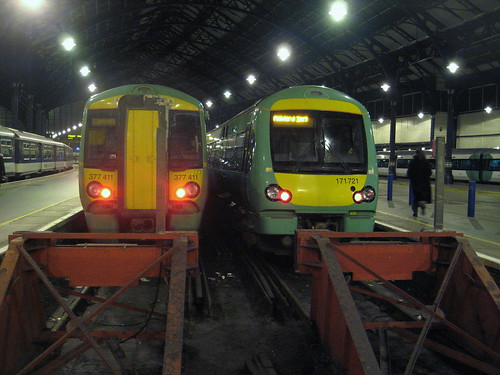
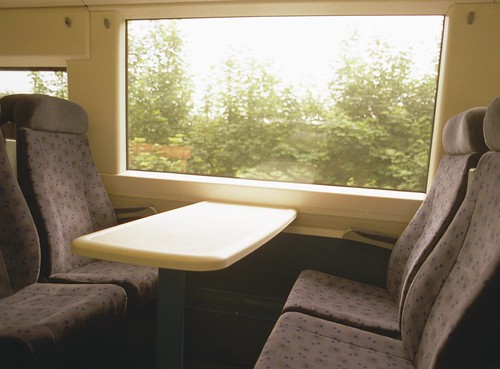
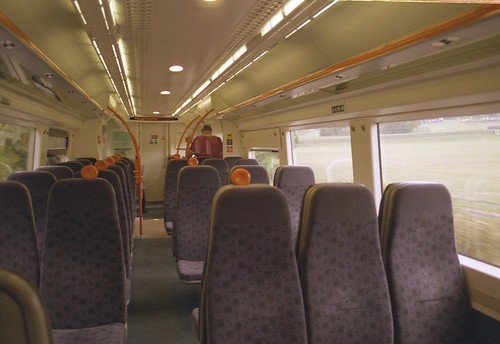
Brighton Station with different sorts of trainsWhitechapel StationVirtuous design - Electrostar train seating bay
Electrostars, the EMU originally developed by AdTranz before it was taken over by Bombardier, are a mixed bunch. The first entered service around 2000 and comprise classes 357, 375, 376, 377, 378 and 379. Originally they were quite unreliable but they are now in the same league as the EPB units which they replaced, dating from the 1960s.

Variations include alternative seating layouts, sliding or plug doors, full width cabs or half-cabs with gangways (top picture), and AC, DC or dual voltage types.

Probably the most successful version is the class 378 for London Overground (second picture), which has sliding doors and longitudinal seating, an ideal layout for the type of service for which they are used.

Some versions are very comfortable, for example the end cars in the units operating on the Southern main lines (third picture) have 2+2 seating with tables, all aligned to the windows.

Much less satisfactory are the vehicles with 2+3 seating. The bodyshells are not wide enough for 2+3 seating, due to the way the bodysides are curved below the window, with the space being further cut into by ducts at skirting level. This reduces the width at floor level, so that passengers sitting by the window cannot put both feet on the ground straight in front of them, and the gangway is so narrow that special catering trolleys had to be obtained.

The reason for this curvature is not clear because the steps project beyond it, and platform levels are always well below the level of the bottom of the bodyside. It appears to be nothing more than a styling feature, and whilst it looks quite elegant, style should not be at the expense of space and comfort.
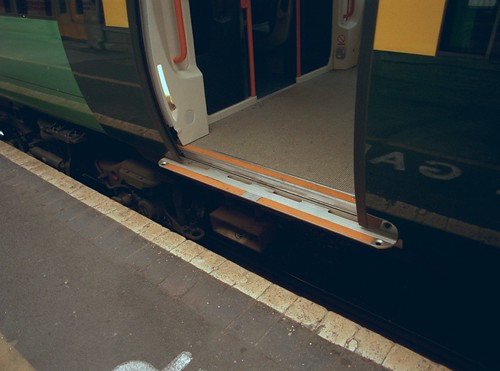
Electrostar train - mind the gap

Another fault is that at concave platforms there is a large gap between the platform and the train. This is due to the position of the doors. The closer the doors are to the bogie centres, the less the gap at curved platforms. Trains such as the end-door class 158 are particularly good from this point of view.

The argument for locating the doors more centrally is that it improves station dwell times, but getting on and off Electrostars at some platforms at stations like Clapham Junction can be a bit of an adventure as there is a chasm to be negotiated. This cannot be good for station dwell time. There is a need for more research on this topic.

One way and another, the Electrostars would benefit from design changes to address these issues before further examples are built.

Kommentarer

Populära inlägg i den här bloggen

Importing people to sustain demand

I got involved in a discussion with a Youtuber called “Philosophy all along”. This was in connection with criticism of Trump’s policy of deporting illegal migrants, which he argued would be bad for the economy as it would reduce demand. This implies that there is a need to import people to sustain demand. There is no obvious reason why a population should not be able to consume everything that the same population produces. If it can not, then something else is going on. It is a basic principle that wages are the least that workers will accept to do a job. Wages are a share of the value added by workers through their wages. The remainder is distributed as economic rent, after government has taken its cut in taxes. Monopoly profit is a temporary surplus that after a delay gets absorbed into economic rent. Land values in Silicon Valley are an example of this; it's like a gold rush. The miners get little out of it. Rent and tax syphon purchasing power away from those who produce the g...

The Zombie Train that refuses to die

The Guardian has published a couple more articles against HS2, one by specialist rail commentator Christian Wolmar, and another today by journalist Simon Jenkins. The main arguments in favour will doubtless be wheeled out by the commentators: the need for capacity and the disruption caused by upgrading existing routes. HST itself will severely disrupt services to Euston during the construction period. Capacity can be increased at a fraction of the cost by a variety of measures, provided that it is accepted that the additional traffic will run at existing speeds. It is not generally known that the Midland main line is, or was, four track all the way from London to Trent Junction, between Nottingham and Derby. This is because the additional tracks are separate, having been added for coal trains which trundled down to Brent sidings, on the edge of London, from a collection point at Toton in Nottinghamshire, where the Midland Railway build a huge marshalling yard. Beyond Derby, the main l...

How much more will the British tolerate?

The British are phlegmatic, tolerant and slow to rouse. Thus there was no great reaction after the terrorist attack in July 2005. The murder of Lee Rigby created a sense of outrage, but nothing more, since it appeared to be an isolated incident. Two serious incidents within a fortnight are another matter. Since the first major terrorist incident in 2001, authority has tried to persuade the public that Islam is a religion of peace, that these were isolated events, or the actions of deranged "lone wolves", having nothing to do with Islam, or to reassure that the chances of being killed in a terrorist attack were infinitesimally small. These assurances are are beginning to wear thin. They no longer convince. If government does not act effectively, people will take the law into their own hands. What, however, would effective action look like? What sort of effective action would not amount to rough justice for a lot of innocent people? Given the difficulties of keeping large n...