Fortsätt till huvudinnehåll

Limits of democracy

Occupy Brighton camp

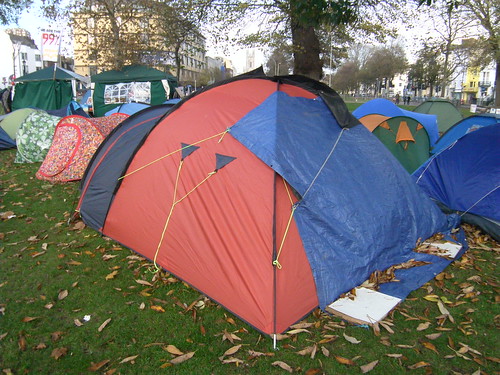
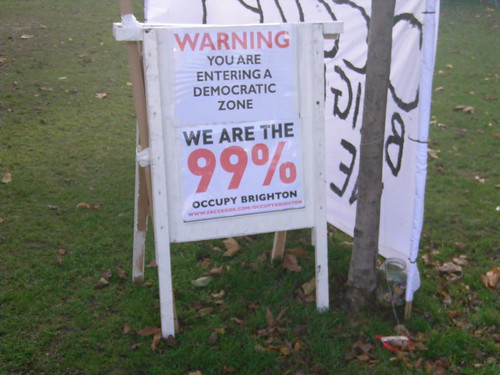
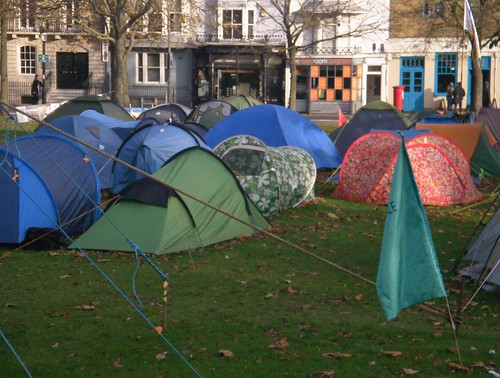
This is the protest camp that has sprung up in Brighton, in Victoria Gardens. It seems to be dominated by the local anarchists. I have a certain sympathy with their anger as they are the generation that is paying for the decades of mismanagement of the economy.

However, a brazier was burning under a large and very old tree, which cannot have been good for it. I suggested that they might like to move it to where there were no tree branches above. I mentioned this to someone there, and she said she accepted the point and would put it to everyone at the meeting. It seems as if there is a democratic structure in which everyone has an equal voice. Perfect democracy, one might say.

Except this. It is worrying that nobody had the sense to realise that fires should not be lit under trees. But in situations like this, there are those who know and those who do not, and giving everyone an equal voice could have a bad outcome. It is like trying to run a ship with a committee made up of the entire crew, and giving them an equal say, when there are some who know about sails or engines, some about cooking, some about navigation, some about radio, some who are normally content to shift heavy stuff around, and so on. You cannot leave technical decisions in the hands of people who are not versed in the relevant discipline.

The Brighton occupation raises another point. Most of the campers seem to be middle class, affecting a working class accent. They have the resources to equip themselves with comfortable, weathertight accommodation. But also in Brighton is a hard core of genuinely homeless people, with nowhere to go, who are living in the streets and sleeping in shop doorways.

I wonder if it has occurred to these concerned anarchists to engage with their neighbours who have fallen through all the safety nets? How would they feel about sharing their well-found accommodation with those much worse-off than themselves?

Kommentarer

Populära inlägg i den här bloggen

Importing people to sustain demand

I got involved in a discussion with a Youtuber called “Philosophy all along”. This was in connection with criticism of Trump’s policy of deporting illegal migrants, which he argued would be bad for the economy as it would reduce demand. This implies that there is a need to import people to sustain demand. There is no obvious reason why a population should not be able to consume everything that the same population produces. If it can not, then something else is going on. It is a basic principle that wages are the least that workers will accept to do a job. Wages are a share of the value added by workers through their wages. The remainder is distributed as economic rent, after government has taken its cut in taxes. Monopoly profit is a temporary surplus that after a delay gets absorbed into economic rent. Land values in Silicon Valley are an example of this; it's like a gold rush. The miners get little out of it. Rent and tax syphon purchasing power away from those who produce the g...

The Zombie Train that refuses to die

The Guardian has published a couple more articles against HS2, one by specialist rail commentator Christian Wolmar, and another today by journalist Simon Jenkins. The main arguments in favour will doubtless be wheeled out by the commentators: the need for capacity and the disruption caused by upgrading existing routes. HST itself will severely disrupt services to Euston during the construction period. Capacity can be increased at a fraction of the cost by a variety of measures, provided that it is accepted that the additional traffic will run at existing speeds. It is not generally known that the Midland main line is, or was, four track all the way from London to Trent Junction, between Nottingham and Derby. This is because the additional tracks are separate, having been added for coal trains which trundled down to Brent sidings, on the edge of London, from a collection point at Toton in Nottinghamshire, where the Midland Railway build a huge marshalling yard. Beyond Derby, the main l...

How much more will the British tolerate?

The British are phlegmatic, tolerant and slow to rouse. Thus there was no great reaction after the terrorist attack in July 2005. The murder of Lee Rigby created a sense of outrage, but nothing more, since it appeared to be an isolated incident. Two serious incidents within a fortnight are another matter. Since the first major terrorist incident in 2001, authority has tried to persuade the public that Islam is a religion of peace, that these were isolated events, or the actions of deranged "lone wolves", having nothing to do with Islam, or to reassure that the chances of being killed in a terrorist attack were infinitesimally small. These assurances are are beginning to wear thin. They no longer convince. If government does not act effectively, people will take the law into their own hands. What, however, would effective action look like? What sort of effective action would not amount to rough justice for a lot of innocent people? Given the difficulties of keeping large n...