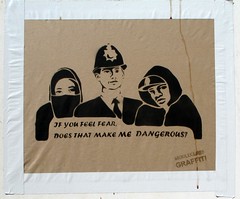
The hoodie is a product of the breakdown of British society, a process that has been running for the past forty years. There are lots of factors - social, political and economic; educational policy obviously has a lot to do with it.
There is a film called, "It's a Wonderful Life" in which a man is shown a vision of what his city would have been if he had never existed. It is not unlike Brighton on a weekend evening, with drunks, fights, the occasional murder. I am not usually around then, but as I make my way every morning through the trail of litter, broken glass and vandalism in the middle of Brighton, past the homeless people huddled in shop doorways, I see no reason to expect that things will improve.
The burka is the one to worry about, and it threatens the whole of European society. That feeds on and gains strength from the so-called "War on Terror". Anyone who talks of such a thing does not know what they are really dealing with, since the ultimate consequence of failure to deal with what it is really about is that the one in the middle will be there to enforce Sharia law.
Prince Charles sees himself as becoming one day a "Defender of Faiths", unfortunately this is a fantasy, as the one in the burka will not tolerate any others. This is a point that has not yet sunk in amongst opinion formers, such an idea being regarded as intolerant and illiberal.
There is a film called, "It's a Wonderful Life" in which a man is shown a vision of what his city would have been if he had never existed. It is not unlike Brighton on a weekend evening, with drunks, fights, the occasional murder. I am not usually around then, but as I make my way every morning through the trail of litter, broken glass and vandalism in the middle of Brighton, past the homeless people huddled in shop doorways, I see no reason to expect that things will improve.
The burka is the one to worry about, and it threatens the whole of European society. That feeds on and gains strength from the so-called "War on Terror". Anyone who talks of such a thing does not know what they are really dealing with, since the ultimate consequence of failure to deal with what it is really about is that the one in the middle will be there to enforce Sharia law.
Prince Charles sees himself as becoming one day a "Defender of Faiths", unfortunately this is a fantasy, as the one in the burka will not tolerate any others. This is a point that has not yet sunk in amongst opinion formers, such an idea being regarded as intolerant and illiberal.
Kommentarer